
In the frame of the work package dedicated to the design and development of a sensor suite for in-flight measurements (HMS) for the ICARUS re-entry demonstrator, DLR (Deutsches Zentrum für Luft- und Raumfahrt e.V.), in collaboration with DEMCON and Pangaia Grado Zero (PGZ), executed the Arcjet test campaign.
This dedicated test effort, performed at the premises of DLR Supersonic and Hypersonic Technologies Department in the Arc-Heated Wind Tunnel L2K in Cologne, aimed to characterize innovative strain gauges (PGZ) and Fibre Bragg Grating temperature sensors (DEMCON) in relevant aerothermal environment, as well as evaluate the temperature distribution in the material and around the sensors measured by thermocouples installed on the ICARUS test article under representative high-enthalpy conditions.
The test outcomes support the validation of thermal models, the refinement of the Health Monitoring System design, and the confirmation of the design solutions adopted within the ICARUS project.



Arc-Heated test
- Evaluate the thermal response of the ICARUS test article, focusing on the temperature evolution measured at selected locations.
Aerothermal test setup
- L2K arc-heated wind tunnel test;
- ICARUS representative test article instrumented with thermocouples positioned at the outer surface in the internal layers;
- Infrared and visible-spectrum cameras;
- High-enthalpy flow conditions representative of re-entry environment.
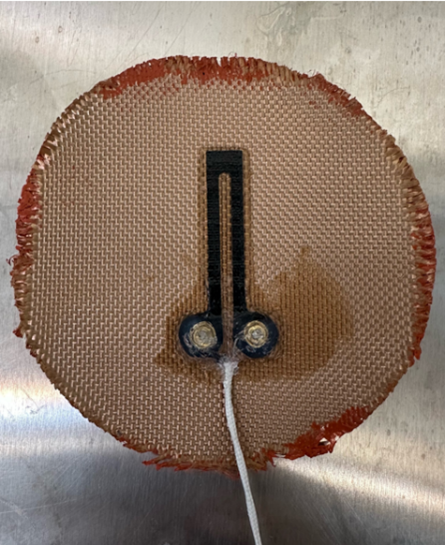
STG-Patch
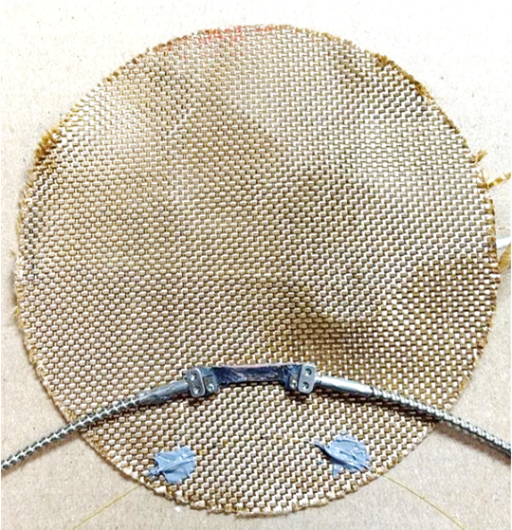
FBG Temperature sensor
Test
- The test article was exposed to high enthalpy flow conditions in the arc heated wind tunnel L2K to reproduce realistic thermal loads.
- Temperature data were acquired with the thermocouples, enabling time-resolved monitoring of the thermal response at critical points. The outer surface temperature was acquired with IR cameras.
- Measurements were conducted with the innovative straing gauges and FBG sensors, and correlated with the classic thermocouple readings.
- Influence of a possible debris-caused probe perforation on the temperature and sensor survivability was investigated.
Outcome
- The measured temperature data provided valuable insight into the thermal behaviour of the system under high-enthalpy conditions.
- Results are being used to correlate numerical simulations and improve the predictive capability of thermal models.
- The thermocouples and the innovative sensors showed a regular and consistent behaviour, successfully withstanding the extreme temperatures experienced during the test.
- The campaign confirmed the effectiveness of the instrumentation strategy for future in-flight measurements.
Arcjet test real footage
Leave a Reply