In early 2025, Dutch ICARUS partner HDES brought the project out of the laboratory and into the classroom, engaging both secondary-school and university students in hands-on activities on launch vehicles, re-entry and inflatable heat-shield technology.
On 18 March 2025, students from the Technasium track at Atlas College in Hoorn presented their Meesterproef “ICARUS SolidFlow”. Guided by Solidflow, the team investigated how cool gas generators could be used to inflate the ICARUS heat shield. Their final presentation walked through the problem definition, the research process and the resulting conceptual designs, including calculations for different gases (H₂, CO₂, N₂, O₂) and a comparison of dimensions and mass for each configuration. The students also reflected on teamwork, task sharing and what they learned from working with an industrial partner on a real European space project.
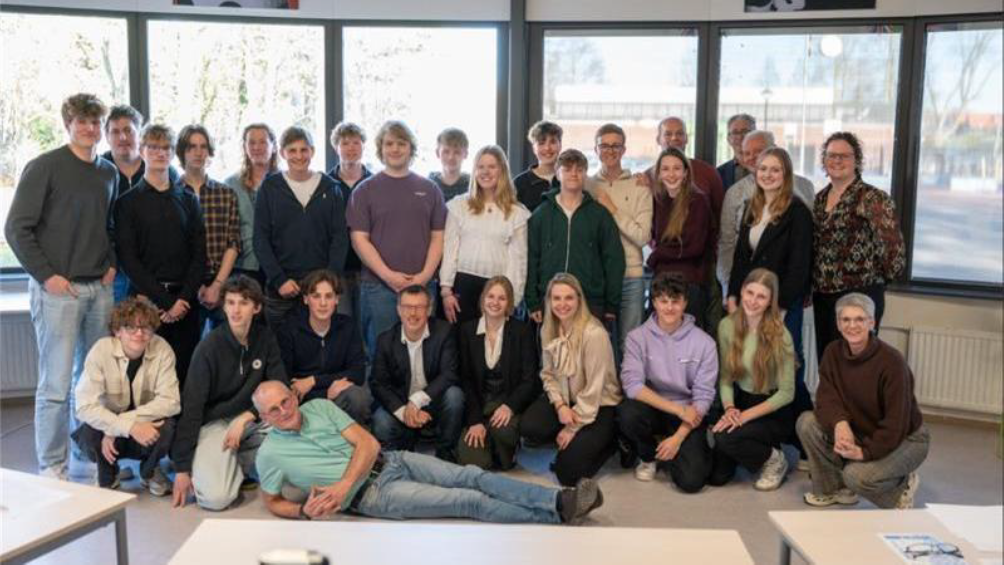
The project closed with a joint session at Atlas College, captured in a group photo that brings together the students, their teachers and representatives from the ICARUS partners. The picture highlights one of ICARUS’ key ambitions: using cutting-edge re-entry technology as a vehicle to inspire and motivate the next generation of STEM talent in Europe.
In parallel, ICARUS was also featured in a dedicated guest lecture on launch vehicle technology at Inholland University of Applied Sciences. Delivered by Berry Sanders (HDES), the lecture introduced students to launcher subsystems, propellants, ground infrastructure, launch preparation, trajectory phases and performance. A special module focused on the ICARUS inflatable heat shield and its CO₂ cool gas generator system, positioning the project within broader developments in reusable launchers and atmospheric re-entry.
The collaboration with Inholland has been further strengthened by a dedicated bachelor graduation project. A BSc student spent six months working at HDES on the design of the ICARUS feed system and the development of a breadboard demonstrator. His thesis combined fluid-dynamic analysis, system design and hardware testing. The examination committee commended the well-balanced mix of analysis and experimentation, making this project a clear example of ICARUS knowledge transfer into academic training.
Together, the Atlas College Meesterproef, the Inholland guest lectures and the ICARUS feed-system bachelor thesis show how ICARUS is already generating value beyond its future flight test: by connecting industry, academia and schools, the project is helping to build the skills and enthusiasm needed for Europe’s next wave of space engineers and technologists.
Leave a Reply